What Happened
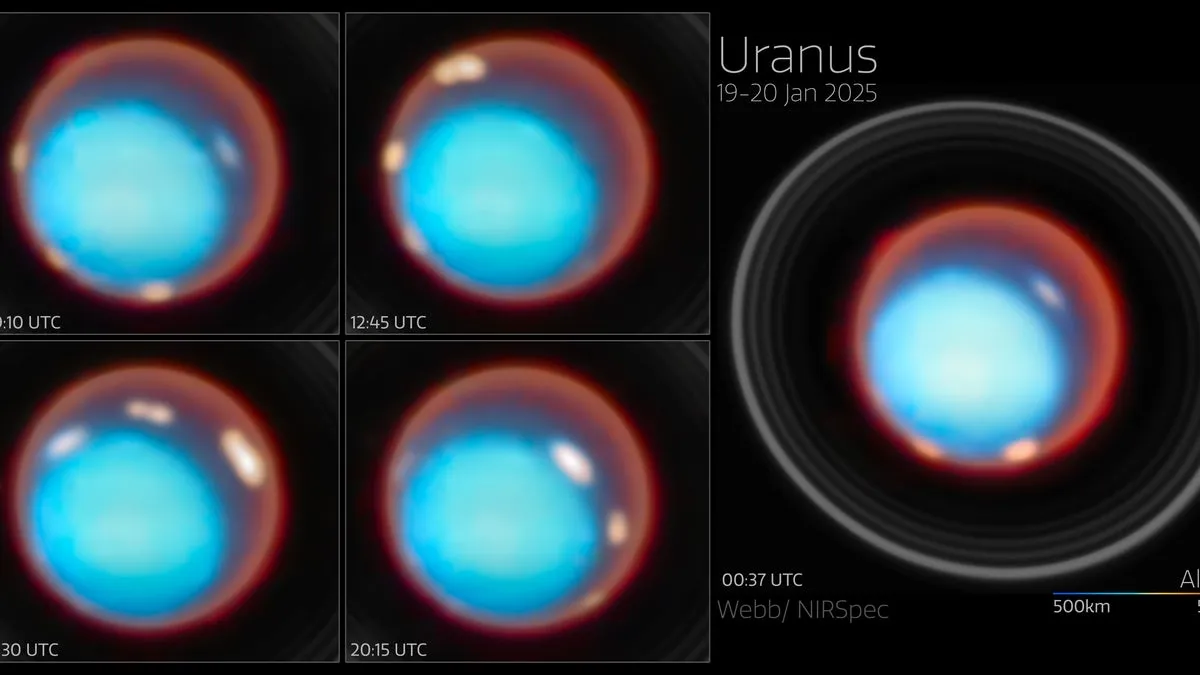
The james webb space telescope (JWST) has recently made significant advancements in our understanding of Uranus and supernova phenomena. In late January 2025, JWST captured multiple views of Uranus, revealing its auroras and providing insights into the planet’s upper atmosphere. This marked the first time astronomers mapped the vertical structure of Uranus’ ionosphere, utilizing the telescope’s Near Infrared Spectrograph (NIRSpec) instrument.
Additionally, on June 29, 2025, astronomers detected a supernova explosion in galaxy NGC 1637, 40 million light-years from Earth. They successfully identified the progenitor star of the supernova using archival images from JWST, which had captured the star in 2024.
Why It Matters
The findings regarding Uranus are crucial as they enhance our understanding of this often-overlooked planet. Uranus, with its unique retrograde rotation and extreme axial tilt, presents a complex environment that could provide answers to various planetary formation questions. The ability to observe its auroras and atmospheric dynamics could lead to new insights into the planet’s climate and magnetic field.
Meanwhile, the identification of the progenitor star of a supernova offers valuable data about stellar evolution and the life cycle of stars. The JWST’s ability to penetrate dust clouds that obscured previous observations by the Hubble Space Telescope allows for unprecedented studies of supernovae and their origins.
What’s Next
As the james webb space telescope continues its mission, further observations of Uranus and other celestial bodies are anticipated. Researchers aim to analyze the data collected from Uranus to deepen their understanding of its atmospheric conditions and magnetic field. Additionally, the findings from the supernova study may prompt further investigations into similar phenomena across the universe, leveraging JWST’s advanced imaging capabilities.