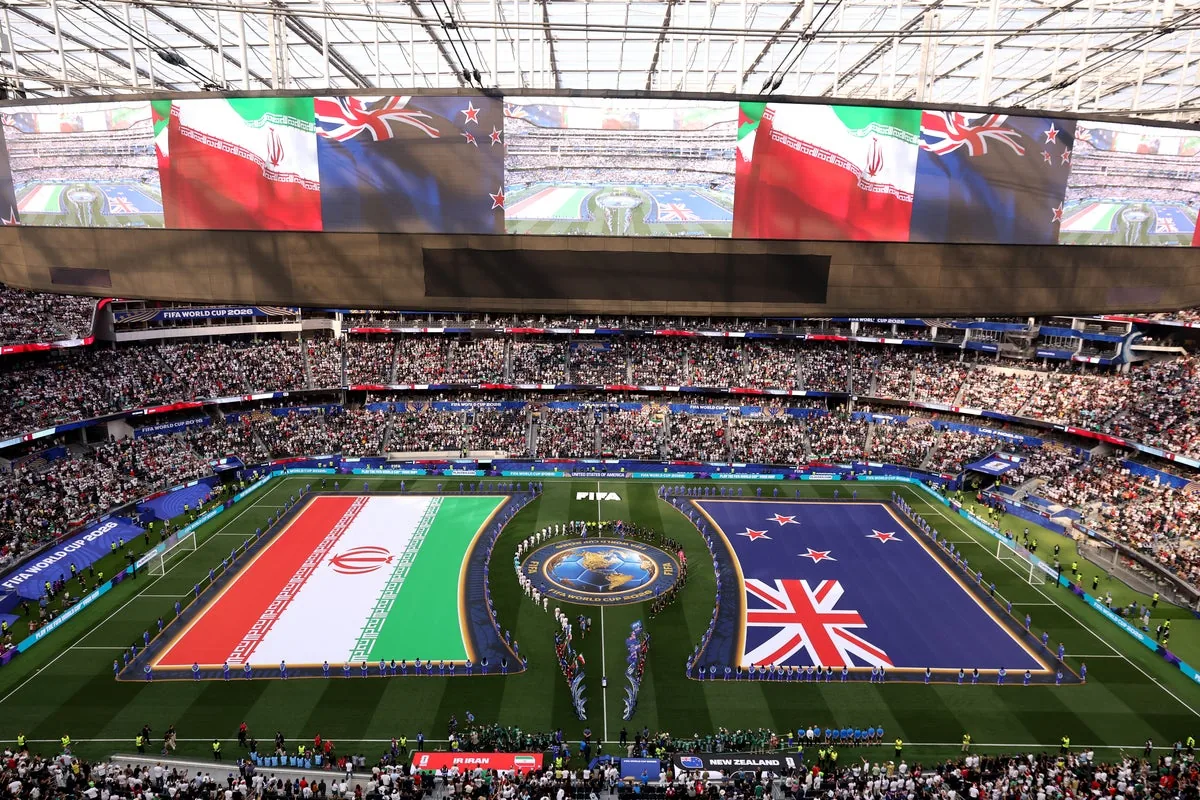
Pre-Match Atmosphere and Protests
The FIFA World Cup 2026 Group G match between Iran and New Zealand took place at SoFi Stadium in Los Angeles. The atmosphere before the game was marked by protests and controversy. Spectators inside the stadium booed the Iranian national anthem as it was played ahead of their opening match.
Outside the stadium, between 300 and 500 protesters gathered, displaying anti-Iranian government signs and flags. These individuals expressed their reluctance to attend the match, stating that doing so would imply support for Tehran. Their protest was directed against the country’s regime and its response to pro-democracy demonstrators.
The match occurred hours after an announcement regarding a preliminary US-Iran peace deal, aimed at ending America’s conflict with Iran. The Iranian team had arrived in the US on Sunday from their training base in Tijuana, Mexico, coinciding with the peace deal announcement.
Los Angeles is home to a significant Iranian community outside of Iran, many of whom left the country after the Islamic Revolution in 1979. The tournament’s backdrop included the conflict, which began in February with US and Israel launching strikes on Iran. This followed nationwide protests in January within Iran, which saw a government crackdown.
Controversies surrounding Iran’s participation also involved the team changing its base from Arizona to Mexico. The Iranian football federation also raised concerns that not all staff received US visas and that tickets allocated to supporters were withdrawn. A US administration official stated that the system would not be abused to allow individuals into the United States under false pretenses.
A ban on the pre-revolutionary Iran flag was upheld following an expedited hearing. The flag, which features a lion-and-sun motif, is historically linked to the country’s previous Shah-led regime. FIFA prohibits flags or apparel deemed to have a political, offensive, or discriminatory nature. Judge Curtis Kin ruled that the ban should stand, citing that while free speech is important, it has limitations, particularly on private property and for private actors.
Match Statistics and Officials
The match saw Iran and New Zealand both vying for a win that would significantly improve their chances of qualifying for the knockout rounds. The referee for the game was César Arturo Ramos Palazuelos, with Erick Yair Miranda Galindo serving as the Video Assistant Referee. The assistant referees were Alberto Morín Méndez and Marco Antonio Bisguerra Mendiola, while Yusuke Araki was the Fourth Official and Fedayi San the Assistant VAR Official.
In terms of basic statistics, Iran recorded 15 shots compared to New Zealand’s 13. However, New Zealand had more shots on target with 7, while Iran had 3. Iran had a higher overall possession. The expected goals (xG) for Iran was 1.4176, slightly higher than New Zealand’s 1.192.
Further attacking statistics show Iran had 7 shots off target, and New Zealand had 4. Both teams had 4 attempts from outside the box. Iran hit the woodwork once, while New Zealand did not. Iran was caught offside twice, with New Zealand not being offside at all. In terms of distribution, New Zealand completed 418 total passes with a 84.7% accuracy, while Iran completed 361 passes with 76.5% accuracy. New Zealand also had more successful final third passes with 68, compared to Iran’s 53.
Defensively, Iran made 15 total tackles, winning 53.3% of them. New Zealand made 11 tackles, winning 72.7%. Iran committed 8 fouls, and New Zealand committed 7. Iran had 24 total clearances, while New Zealand had 18. Both teams had one point in Group G, with Iran in position 1 and New Zealand in position 2.
Read Also
Source: bbc.co.uk