
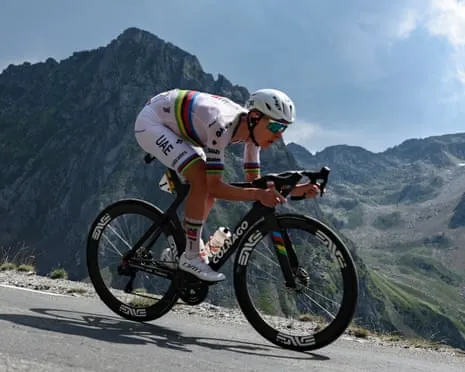
Tadej Pogacar secured a decisive victory on stage six of the Tour de France, riding solo to the summit of the Col du Tourmalet in the Hautes-Pyrénées before continuing to the finish line at Gavarnie-Gèdre. This performance established a significant overall lead in the 2026 race.
Under the watchful eye of President Emmanuel Macron, Pogacar’s display was described as imperious. His long-standing rival, Jonas Vingegaard, attempted to keep pace but ultimately conceded 2:38 to the leader by the stage’s end, not even contesting the sprint for the finish line. Pogacar’s lead, which was under half a minute at La Mongie ski station, extended to nearly three minutes by the time he reached Gavarnie-Gèdre.
Pogacar’s solo effort on the Tourmalet, a characteristic move for him, was noted for its impact on his competitors’ morale. His lead over the peloton is now considered both physical and psychological, with rivals potentially focusing on podium or top-five finishes rather than challenging for the overall win.
Dominance in the Mountains
The stage, which ventured deep into the Pyrenees, included formidable climbs such as the Col d’Aspin and the much-feared Col du Tourmalet. The pace set by Pogacar’s UAE Team Emirates XRG at the base of the Tourmalet was intense, transforming the 17 kilometres of climbing into a platform for Pogacar and a challenging section for others.
The peloton was reduced to 16 riders by the midpoint of the climb. Among those who struggled to maintain the pace were Thymen Arensman, leading the Netcompany Ineos team in the absence of an injured Oscar Onley, and Tom Pidcock of Pinarello Q36.5. The then-race leader, Torstein Traeen, experienced a difficult day, falling behind the group of favourites with 11km remaining on the Tourmalet. He later crashed on the descent, finishing nearly 30 minutes behind Pogacar after receiving medical attention.
Five kilometres from the Tourmalet summit, as the lead group entered La Mongie, Pogacar and teammate Isaac del Toro moved ahead, with Pogacar then pushing on alone. Despite Vingegaard’s initial efforts to limit the time gap on the climb’s final ramps, Pogacar’s attack also highlighted the difficulties faced by riders like Paul Seixas, who had previously competed closely with the Slovenian.
Impact on the Race
Pogacar’s performance marks his 23rd stage win in the Tour de France, including 11 in the Pyrenees, making him the fifth most prolific stage winner in the race’s history. He has already secured two stage victories in this year’s Tour, with another gifted to his teammate Del Toro, indicating his strong control over the race.
The early stages of the 2026 Tour have been particularly demanding, with the combination of Pogacar’s dominance, the Pyrenean climbs, and the heat contributing to an increasing number of riders abandoning the race. Cian Uijtdebroeks of the Movistar team, for example, withdrew due to gastrointestinal problems and a fever.

The stage began with an early breakaway attempt by Victor Campanaerts and Mads Pedersen, who were later joined by Huub Artz. Pedersen secured points at an intermediate sprint before being reabsorbed by the peloton. Other riders, including Ben O’Connor and Xabier Mikel Azparren, also made efforts to break away on earlier climbs.
Vingegaard, taking precautions against infection, wore a mask before the stage, having been involved in a stressful finish on the previous day. The race saw one non-starter, Alex Molenaar, who had crashed heavily on the prior day.
The day’s weather was hot, with a risk of thunderstorms, though none materialised during the race.

The race is set to conclude in Paris on 26 July.
Read Also
Source: theguardian.com