Scotland is set to face Brazil in Miami, with a draw securing their place in the knockout stage of the World Cup. Even a narrow defeat might see them progress to the last 32 as one of the best third-placed teams. The focus among fans has shifted to the third-placed teams’ table as they try to determine the exact scenario for the national side to advance for the first time.
Head coach Steve Clarke and the players will be questioned about their approach given these circumstances. However, playing solely to avoid defeat can be challenging. Former Scotland player and manager Craig Levein highlighted the dangers of playing for a draw, noting that if a team concedes a goal, it becomes difficult to shift out of that defensive mindset. He recalled a match against the Czech Republic in 2010 where a draw would have been a good result, but a set-piece goal led to a loss.
Tactical Approach Against Brazil
Levein believes that Clarke’s demeanor, training approach, game plan, and team selection will be more influential on the players’ mindset than external discussions about needing only a point. The potential inclusion of winger Ben Gannon-Doak could signal a more aggressive attacking strategy from Scotland. Levein suggested that adding an attacking player might encourage the team to adopt a more offensive stance.
A cautious game plan, even when aiming to win, might pose an issue for Scotland. In their match against Haiti, Clarke’s side maintained 46% possession, which dropped to 40% against Morocco. Scotland has registered only two shots on target in the tournament so far. Defensively, they have not consistently pressed opponents aggressively, taking an average of 25 seconds to recover possession against Morocco, who recovered the ball eight seconds faster on average.
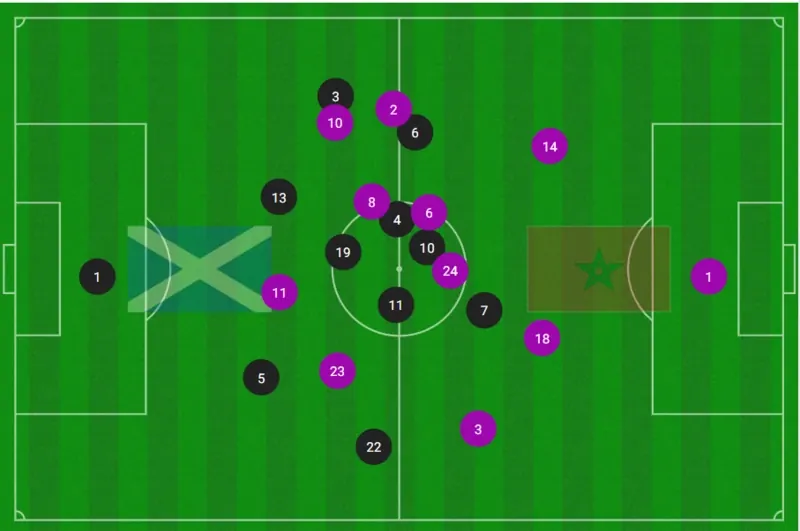
Former Hibernian and Celtic midfielder Scott Allan noted that a passive approach can lead players to worry rather than believe in their ability to create and score goals. He emphasized that even when playing a low block, a team can still be aggressive by pressing opponents with purpose when they reach a certain point on the pitch. Former Rangers and Motherwell midfielder Andy Halliday echoed this sentiment, stressing the need for more urgency in defending as a team against Brazil.
Halliday suggested that if Scotland intends to sit deep and frustrate their opponents, they must be quick in transitions. He believes the team needs to be much more aggressive off the ball than they have been. He observed that Scotland’s chances against Morocco originated from pressing their players and winning the ball high up the pitch. While not expecting a significant difference in possession against Brazil, Halliday emphasized that Scotland cannot afford to give Brazil’s top players time and space on the ball.
Squad Dynamics and Future Outlook
The permutations surrounding Scotland’s qualification are a dominant topic among fans. After Ismael Saibari scored for Morocco early in their match against Scotland, goal difference became a key factor for those hoping for Scotland to make history. Despite a 1-0 defeat to Morocco, Scotland’s goal difference returned to zero, preventing an early elimination while on three points. The upcoming match against Brazil is crucial.
Scotland is in an unusual position. Avoiding a heavy defeat against Brazil, which was demonstrated as feasible against Morocco, offers them a decent chance of advancing to the last 32. However, certainty regarding stage-one outcomes is difficult due to many remaining matches. Group B presents challenges for Scotland, as a win for Bosnia and Herzegovina against Qatar would put three teams on at least four points. Similarly, in Group D, Australia and Paraguay, both already on three points, will play their final game. Teams finishing their group stage after Scotland will know precisely what they need to do for qualification. Clarke has stated that he is unwilling to focus on qualification possibilities or probabilities, asserting that his squad will aim to win the game, and if not, avoid losing it.
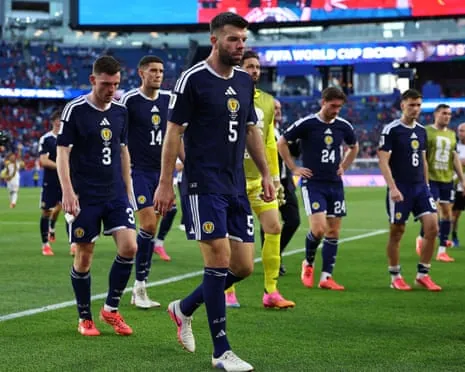
A broader perspective suggests that Scotland is short on game-changing talent, especially if they advance from Group C largely due to their 1-0 win against Haiti. This victory marked only their fourth goal in eight tournament appearances under Clarke, with two goals coming from deflections and one being a consolation in a 5-1 loss to Germany. The technical level of attacking players in countries of comparable size, such as Norway, is considered to be significantly higher than what Clarke has available. While Scotland’s team displays a strong attitude and has achieved success after a long period of international struggles, they are seen as a limited side.
If Scotland qualifies for the last 32, it would be a new achievement, but elevating the current squad above past teams, such as the 1974 squad, would be an overstatement. The issue is considered a problem for Scottish football as a whole, rather than solely for Steve Clarke. There is a suggestion that clubs should be incentivized to develop homegrown players. This marks Scotland’s third tournament qualification out of four. The average age of the starting eleven against Morocco was closer to 30 than 29. Clarke has signed on for another four years with the goal of developing a new generation of squad members.
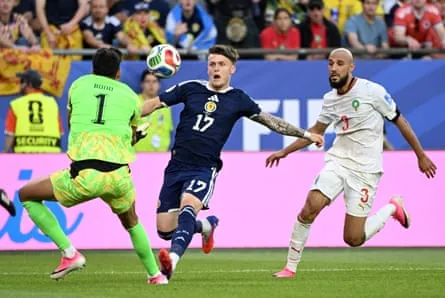
Ben Gannon-Doak continues to offer hope for the team. Clarke has a tendency to downplay the hype surrounding the Bournemouth winger, which is understandable for a manager. The player is lightly experienced in club football. However, there is external excitement for Gannon-Doak as Scots desire a star player. Clarke praised Gannon-Doak’s impact as a substitute against Morocco, noting his unpredictability and different threat. He suggested that the match against Brazil might require a different approach, potentially involving Gannon-Doak. Clarke could address criticisms about a lack of ambition by utilizing Gannon-Doak, given Scotland’s need for a difference-maker.
After the Morocco match, Scotland expressed frustration over what they believed were unawarded penalties for John McGinn and Scott McTominay. Clarke implied that Morocco should have been reduced to 10 men. The apparent refusal of video assistant referees to intervene in games during this World Cup, while potentially a deliberate approach, impacted Scotland in this instance. It is also noted that a penalty was not given against Grant Hanley for handball in the Haiti fixture. Scotland’s destiny is in their own hands, with a draw against Brazil potentially securing a knockout phase spot.
Read Also
Source: bbc.co.uk