Controversial moment in Canada-Bosnia match
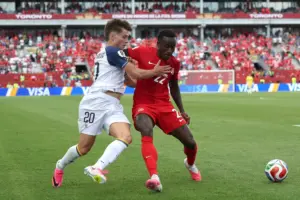
A recent World Cup 2026 match between Canada and Bosnia-Herzegovina, which ended in a 1-1 draw, has led to a discussion among pundits regarding a potential red card incident. The draw marked the first time Canada, as co-hosts, avoided defeat in seven World Cup matches.
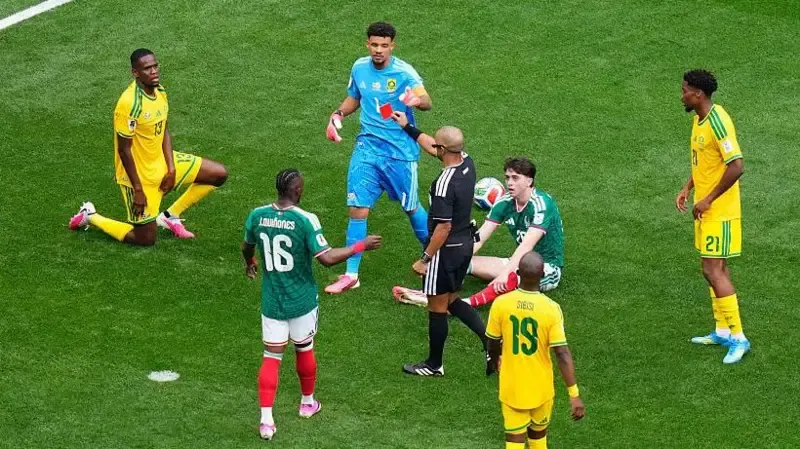
The incident occurred four minutes into the second half while Bosnia was leading 1-0. Bosnia goalkeeper Nikola Vasilj jumped to punch a long ball, and in his follow-through, his fists made contact with the head of Canada striker Tani Oluwaseyi. An offside call was made, which would have negated a penalty, but the question of a red card for Vasilj remained.
Pundits divided on decision
Former England captain Wayne Rooney argued that Vasilj should have been sent off, describing the play as very dangerous. He noted that despite the goalkeeper winning the ball, the follow-through hit Oluwaseyi in a vulnerable area, potentially leading to serious injury such as a delayed concussion. Rooney compared it to situations where players are sent off for dangerous tackles with their legs, suggesting that the same principle should apply to hands.
Conversely, former Premier League assistant referee Darren Cann supported the decision made by Argentine referee Facundo Tello to take no action. Cann, who served as an assistant referee in the 2014 World Cup final, stated that even without the offside, it was neither a penalty nor a red card. He explained that the goalkeeper clearly played the ball first, and the subsequent contact was inevitable, therefore not constituting serious foul play.
The rules state that a tackle or challenge endangering an opponent’s safety or using excessive force must be sanctioned as serious foul play. This includes lunging at an opponent with excessive force or endangering their safety while challenging for the ball.
Former France forward Olivier Giroud offered a perspective that acknowledged both sides of the argument. He expressed that as a striker, he would have felt frustrated not to receive a penalty. However, he also understood Cann’s point that it is difficult for a goalkeeper to avoid contact after hitting the ball first.
Canada’s World Cup campaign and squad details
Canada is co-hosting the World Cup 2026 alongside Mexico and the United States, marking their third appearance in the tournament after participating in the 1986 and 2022 editions. Manager Jesse Marsch has described his 26-man squad as the best ever assembled, with high expectations for the team to advance past the group stages for the first time.
The squad includes notable players such as Bayern Munich’s Alphonso Davies, who is considered a key player but was in a race to be fit for the first match against Bosnia & Herzegovina on June 12 due to a hamstring injury. Other players include goalkeepers Dayne St Clair, Maxime Crepeau, and Owen Goodman; defenders Alistair Johnston, Derek Cornelius, and Richie Laryea; midfielders Stephen Eustaquio, Ismael Kone, and Tajon Buchanan; and forwards Jonathan David, Cyle Larin, and Tani Oluwaseyi. Niko Sigur is highlighted as a breakout talent, capable of playing at right-back and defensive midfield.
Bosnia & Herzegovina returned to the World Cup after a 12-year absence, securing their spot through European qualifying play-offs. Their squad features Edin Dzeko, who is making his second World Cup appearance at the age of 40, and defender Sead Kolasinac. Kerim Alajbegovic is noted as a breakout talent for Bosnia.
The expanded World Cup format, featuring 48 teams, allows eight of the 12 third-place finishers to advance, providing more opportunities for teams like Canada and Bosnia & Herzegovina to progress to the knockout rounds. Canada’s next fixture is against Qatar on June 18 at BC Place Vancouver.
Read Also
Source: bbc.co.uk