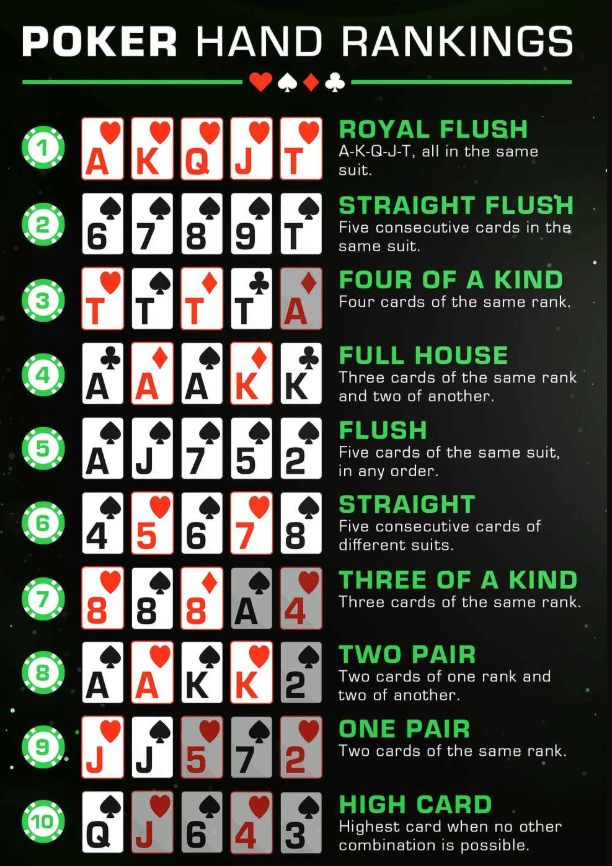
A player reads the table more calmly when the order of combinations is clear before the cards are exposed. In practical terms, poker hands ranked means that every five-card result has a fixed position, from the weakest high card to the strongest royal flush. This order is used to compare results at showdown, but it also helps earlier in the hand when a player decides whether a draw, pair or made combination is worth continuing. The same basic ladder applies across common formats, although each game may have its own card-use rules. Beginners often confuse attractive starting cards with a finished result, especially when the community board changes the value of several hands at once. A careful player treats poker hands as final five-card combinations, not as isolated private cards.
Quick poker hands chart for reading ranked combinations
A compact reference gives new players a way to compare combinations without stopping the flow of the game. The purpose of poker hands ranked is to show which category beats another and why the order does not change just because a hand looks strong at first glance. A chart is most useful when it includes names, examples and a short note about common confusion. The player can then recognise whether the board gives a real made hand or only a possible draw. A clear poker hands chart also helps online players who need to make decisions quickly. It should support table reading rather than replace attention to position, betting and opponent action.
Chart symbols that help compare cards faster
Visual examples reduce hesitation because card names alone can sound similar to beginners. A useful poker hands chart places each hand category in order and shows a sample combination that can be checked at a glance. The strongest result is royal flush, while high card sits at the bottom when no pair or better appears. Suits only matter when they make a flush; clubs, hearts, spades and diamonds do not outrank each other by themselves. Standard poker hand rankings also require tie-breaker knowledge, because two players can hold the same category. The table below shows the core ladder with simple examples and common reading notes.
| Rank | Hand name | Example cards | Beats | Beginner note |
| 1 | Royal flush | A-K-Q-J-10 same suit | Every other hand | Highest possible straight flush |
| 2 | Straight flush | 9-8-7-6-5 same suit | Four of a kind and below | Connected cards in one suit |
| 3 | Four of a kind | Q-Q-Q-Q-4 | Full house and below | Kicker can matter on board quads |
| 4 | Full house | 10-10-10-6-6 | Flush and below | Three of a kind plus one pair |
| 5 | Flush | A-J-8-5-2 same suit | Straight and below | Highest card separates equal flushes |
| 6 | Straight | 8-7-6-5-4 mixed suits | Three of a kind and below | Ace can be high or low |
| 7 | Three of a kind | 9-9-9-K-3 | Two pair and below | Side cards can still decide |
| 8 | Two pair | J-J-4-4-A | One pair and below | Higher pair is compared first |
| 9 | One pair | 7-7-A-Q-2 | High card | Pair rank comes before kickers |
| 10 | High card | A-J-9-6-3 | Nothing below it | Used when no player pairs |
Comparing categories before kickers in poker hands ranked
The chart should be read from top to bottom when comparing categories. A player should not move straight to kickers before identifying whether the hand category is already beaten. For example, a flush defeats any straight, no matter how high that straight looks. At the same time, an ace-high flush can lose to a full house, because the category above it matters more than the top card. This is where poker hands ranked becomes more than memorisation. It gives the player a stable comparison method when several cards seem important.
From high card to royal flush in order
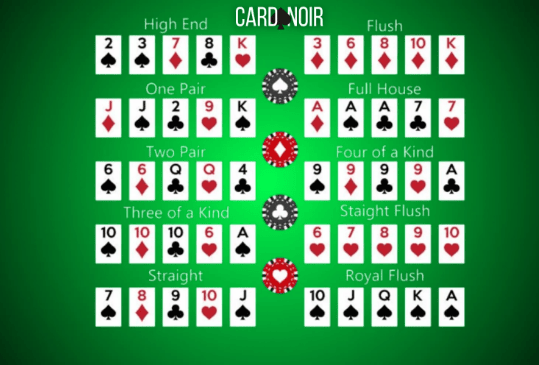
Some learners prefer to study from the bottom upward because each step shows what improves the result. A basic poker hands list begins with high card, then one pair, two pair, three of a kind, straight, flush, full house, four of a kind, straight flush and royal flush. This bottom-up view makes the gap between similar hands easier to understand. One pair may win many small pots, but it remains far below a straight or flush when stronger categories appear. The phrase poker hands ranked should therefore be understood as a ladder of final results, not as a list of favourite cards. A player who knows the ladder can stop overvaluing a single high card when the board clearly supports stronger combinations.
Standard poker hand rankings across common game formats
A correct comparison starts with category, then moves to card ranks inside that category. Standard poker hand rankings explain why a straight beats three of a kind and why a full house beats a flush. After that first comparison, details such as kicker, highest card or paired rank can decide close results. The phrase poker hands in order covers the full hierarchy, while tie-breakers explain what happens when categories match. New players often look only at their private cards and miss that the board can help every seat. Real hand reading uses the best five-card result available under the rules of the format being played.
Pair, straight and flush comparisons at showdown
Pairs, straights and flushes create many early mistakes because they appear often and can shift value as the board changes. In poker hand rankings, one pair is lower than two pair, and two pair is lower than three of a kind. A straight beats three of a kind because five connected ranks form a stronger category. A flush beats a straight because five cards of one suit are ranked above any non-flush sequence. When two players both have a flush, the highest card in the flush is compared first. In poker hands ranking decisions, the same habit applies: identify the category, then compare the ranks that actually count.
Common formats where hand order still applies
Game format can change how a final hand is built, but the usual ranking ladder remains familiar. Texas Hold’em lets a player use any five cards from private cards and community cards. Omaha normally has stricter card-use rules, so a player must not assume that all visible combinations are playable. Casino table variants may add side bets or house rules, but the central order still guides the main comparison. The idea of poker hands in order gives a foundation before those format details appear.
- Royal flush: The highest straight flush, running from ten to ace in one suit.
- Straight flush: Five connected cards of the same suit.
- Four of a kind: Four cards of the same rank.
- Full house: Three of a kind plus one pair.
- Flush: Five cards of the same suit without sequence.
- Straight: Five connected cards in mixed suits.
- Three of a kind: Three cards of one rank.
- Two pair: Two separate pairs plus a kicker.
- One pair: Two cards of one rank.
- High card: No pair or stronger combination.
This order gives the player a reference point before betting strategy becomes more complex. A strong draw is not the same as a made hand, and a pair does not outrank a completed straight. In every format, the player should first confirm which five cards are allowed to form the result. The same poker hands ranking ladder then helps compare the final combination. Strategy, position and stack size can affect decisions, but they do not make a lower category beat a higher one. That separation keeps table reading more accurate.
Winning poker hands and starting hand strength explained
A winning result depends on the final five cards, not only on the cards dealt at the start. Players often call pocket aces, kings and ace-king suited the best poker hands, but those hands can lose when the board creates a stronger category for another player. At showdown, poker winning hands are the hands that survive all category and tie-breaker comparisons. This is why a premium pair before the flop can become only one pair by the river. A smaller starting hand can make a straight, flush or full house if the board develops in its favour. The player needs to read the whole hand, not just the opening strength.
Showdown results, split pots and final card value
Showdown comparison begins after betting ends and active players reveal their cards. The phrase poker winning hands describes the final combinations that take the pot, including situations where two or more players split it. A split pot happens when the best five-card hand is exactly the same for multiple players. This can occur when the board itself creates the best available result, or when kickers do not change the final five cards. A player who understands poker hands ranked can recognise when a private card matters and when it is irrelevant. This knowledge prevents arguments over extra cards that are not part of the final hand.
Strong starting cards after flop and board changes
Strong starting cards give a useful advantage, but they do not finish the hand alone. Pocket aces are often treated as one of the best poker hands before the flop, yet a coordinated board can create straight or flush threats quickly. After community cards appear, value depends on category, board texture, opponent range and kicker quality. The idea of poker hand strength changes from street to street because each new card can complete or weaken possible hands. A top pair may become vulnerable when a fourth suited card arrives.
- Board texture: Connected or suited cards can create straight and flush threats.
- Position: Acting later gives more information before making a decision.
- Opponent range: Tight and loose players represent different possible holdings.
- Kicker quality: Equal pairs are often separated by the side card.
- Shared board: Community cards can reduce private-card advantage.
These factors do not change the ranking ladder, but they change how confident a player should feel. A hand can start strong and become only medium strength by the river. Another hand can begin quietly and improve into a category that dominates earlier favourites. In this sense, poker winning hands are confirmed at the end, not declared at the start. A player who keeps reading the board avoids treating a premium start as automatic success. That discipline matters in both casual games and casino environments.
Common ranking mistakes that affect table decisions
Many costly errors happen when players remember hand names but not comparison rules. A person may know the phrase poker hands ranking and still misread a board where everyone shares the same two pair. Another common mistake is counting six or seven cards instead of choosing the best five-card result. Community cards can counterfeit a private pair, lower the value of a kicker or create a split that was not obvious at first. In these spots, poker hands need to be checked against the full board. The best decision comes from category, rank and kicker, not from the first impression of private cards.
Kicker errors in close five-card comparisons
Kickers matter when players share the same hand category and need side cards to separate the result. The idea of poker hand strength includes the made hand and the relevant cards that complete the five-card comparison. A pair of aces with a king kicker can beat a pair of aces with a queen kicker when no stronger category exists. However, a kicker does not matter if the board already supplies the best five-card hand for both players. In poker hands ranked situations, the player must decide whether the side card is actually part of the final result. This is where beginners often overvalue a card that cannot change the outcome.
| Pros | Cons |
| Learning the order helps players avoid basic showdown errors, recognise split pots faster and compare made hands without guessing under pressure. Board reading also becomes easier when category and kicker are checked separately. | Memorising a chart can create overconfidence when the player ignores board texture, opponent range and the fact that only five cards form the final result. |
| Kicker practice improves decisions in one-pair and two-pair pots, especially when the same visible cards help several players. It also reduces emotional calls with hands that look strong but lose to a better side card. | A fixed ladder does not explain every strategic spot, because betting action, position and format rules can change how a hand should be played. |
Community cards changing the strongest available hand
The hierarchy does not change, but the best available result can change on every street. A player holding top pair may feel comfortable until the turn completes a flush or the river pairs the board. The phrase poker hands ranking stays fixed, while the actual winning category can move from pair to straight, flush or full house as cards arrive. This is why poker hands should be rechecked after flop, turn and river. A board with four cards of one suit makes any high card of that suit important. A paired board can also create full house possibilities that beat hands players sometimes overvalue.
River card reading for final poker hand strength
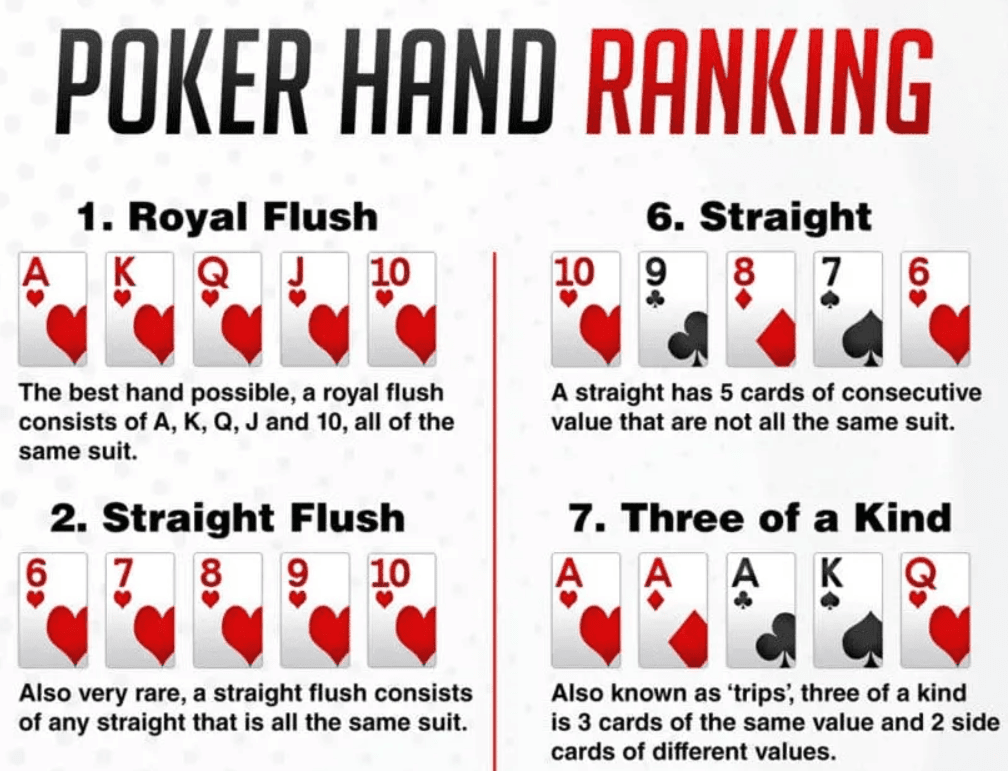
The river card is the last point where the final five-card result becomes clear. A player should compare the completed board with private cards before assuming that an earlier pair or draw is still strong. At this stage, poker hand strength depends on the best available category, the highest relevant ranks and any kicker that still counts. A missed draw can leave only high card or one pair, while a completed flush or straight can change the entire showdown. The order from poker hands ranked helps the player avoid treating a weaker made hand as stronger than it really is. Shared board combinations also need attention because two players can end with the same five-card result. A calm river check reduces mistakes when the pot feels important and several outcomes look possible.
FAQ about ranked poker combinations for new players
What does ranked hand order mean for beginners?
Ranked hand order shows which five-card combination beats another at showdown. It starts with high card and moves upward through pairs, straights, flushes, full houses and stronger results. This order helps beginners compare cards without guessing. It also gives them a simple base before they start learning kickers, split pots and board reading.
How are two similar hands compared?
Two similar hands are compared first by category and then by the ranks inside that category. If both players have the same pair, straight or flush type, the relevant highest cards decide the result. When the best five-card hand is identical, the pot is split. This method prevents confusion when both players appear to have nearly the same result.
Why can a strong starting hand lose later?
A strong starting hand can lose when the board creates a better final combination for another player. For example, a pair can be beaten by a straight, flush or full house after community cards appear. The final result depends on the best five cards, not only the first two cards. That is why each new board card should be checked before assuming the hand is still ahead.
Which chart is best for learning combinations?
A useful chart should show the full order, example cards and short notes about common ties. It should be easy to scan and should not mix too much strategy into basic ranking rules. New players can use it first for memory, then practise reading boards naturally. The best chart also explains kickers and shared-board situations in simple examples.