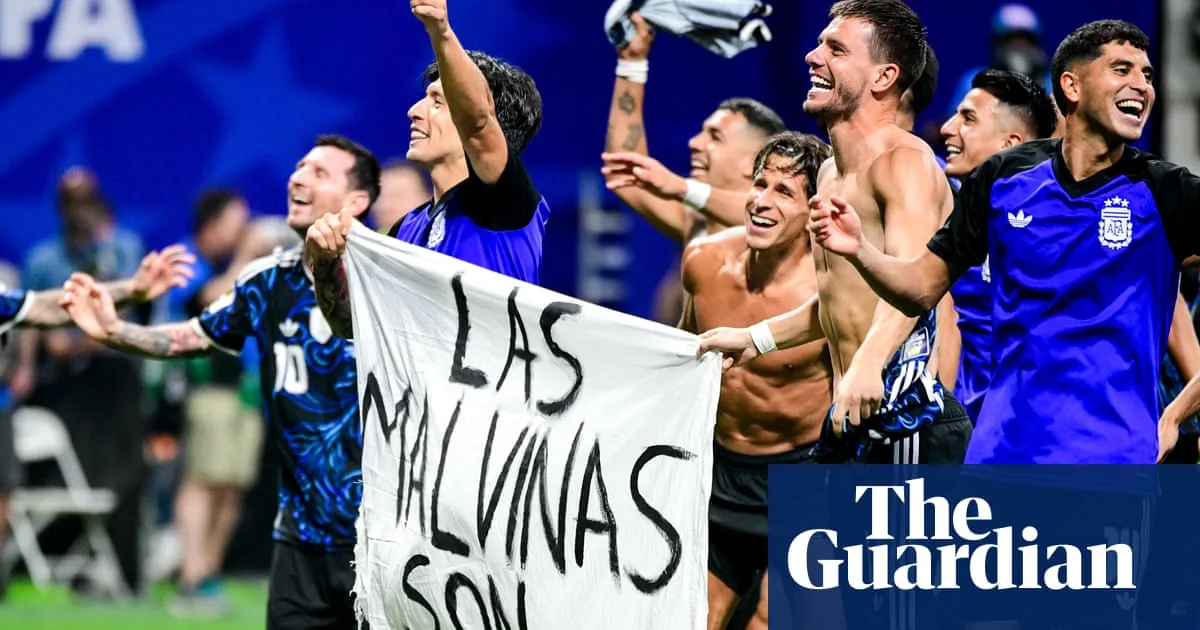
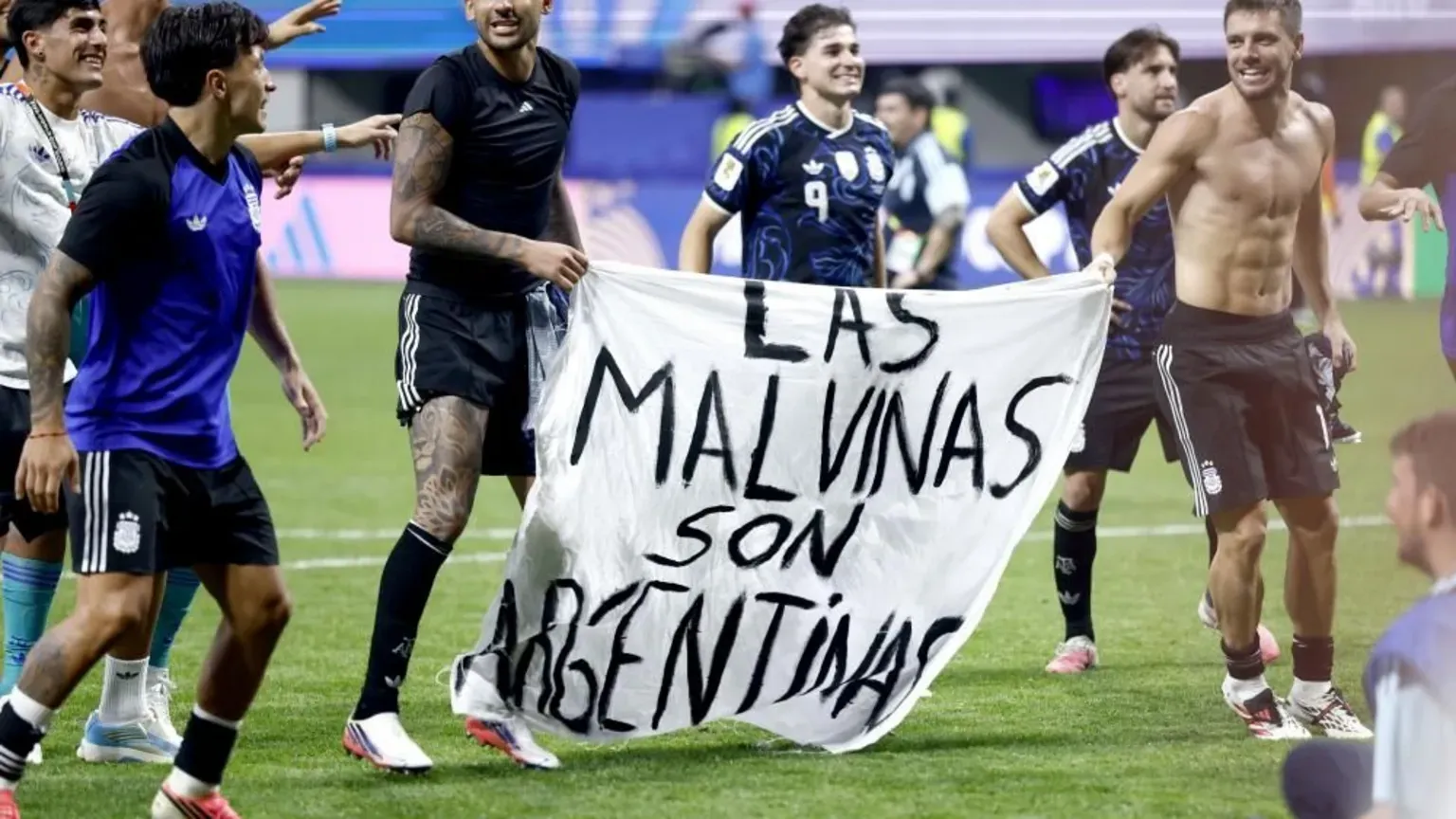
Fifa is currently evaluating match reports following an incident where Argentina players displayed a banner referencing the Falkland Islands after their World Cup semi-final victory against England. The banner, which read “Las Malvinas son Argentinas” (The Falklands are Argentine), was shown after Argentina secured a 2-1 win in Atlanta, advancing them to the final against Spain.
The Falkland Islands are a British overseas territory located in the south-west Atlantic Ocean and remain a point of contention between the UK and Argentina. A Fifa spokesperson confirmed that the independent disciplinary committee is reviewing the circumstances to determine potential further steps, adhering to the Fifa disciplinary code.
This is not the first instance of Argentina’s football association facing repercussions for such a display. In 2014, the association was fined for showing a similar banner before a friendly match against Slovenia. At that time, world football’s governing body stated that the gesture violated rules concerning political action and team misconduct.
Reactions and Calls for Investigation
The incident has drawn significant reactions from various political figures. Downing Street has supported calls for Fifa to investigate, with the prime minister’s official spokesperson stating that while the World Cup might not belong to the UK, the Falkland Islands “definitely are,” and that the UK’s commitment to the islands will not waver. Argentina’s President Javier Milei, according to media reports, described the players’ actions as “understandable” and “valid,” but also clarified that “the things that happen on the pitch are not part of diplomacy.” He added that the Malvinas are Argentine and that their recovery would be pursued through diplomatic means.
The Falkland Islands government expressed disappointment regarding the banner, hoping that Fifa would “sanction all behaviour of this nature in line with its own rules.” They also emphasised a desire to keep politics out of sport. Peter Kyle, the business and trade secretary, stressed the importance of separating politics from the World Cup and urged Fifa to conduct a thorough investigation. Kemi Badenoch, the leader of the Conservative Party, echoed these sentiments, stating that Fifa “absolutely should investigate.”
Liberal Democrat leader Ed Davey has called for the Argentina players involved in holding the banner to be suspended for the upcoming final against Spain. He referenced a precedent where Uefa banned Spain players Alvaro Morata and Rodri for one game after they chanted “Gibraltar is Spanish” during Euro 2024 celebrations. Gibraltar, an enclave at Spain’s southern tip, has been under British rule since the 18th century, with Spain long advocating for its return.
Historical Context and Previous Sanctions
The sovereignty dispute over the Falkland Islands has a significant history. In 1982, Argentina, then under a military junta led by General Leopoldo Galtieri, invaded the islands, which are situated 300 miles off Argentina’s east coast. The conflict, lasting 74 days from April to June 1982, resulted in the deaths of 649 Argentine and 255 British servicemen, along with three islanders. In 2013, the people of the Falkland Islands voted overwhelmingly to remain a UK overseas territory, with 1,513 votes in favour out of 1,517 cast in a referendum that saw over 90% turnout.
Fifa has a history of taking disciplinary action for breaches of regulations, particularly concerning political actions. A notable example involves South Korea midfielder Park Jong-woo, who, after the 2012 Olympic Games bronze medal match, displayed a sign in Korean that read “Dokdo is our territory.” Dokdo, also known as Liancourt Rocks, is a group of inlets administered by South Korea but claimed by Japan. Park was charged by Fifa and subsequently received a two-match suspension, which meant he missed two World Cup qualifiers.
The prime minister’s official spokeswoman reiterated the UK’s position, stating, “Our position is unchanged, self-determination rests with the islanders and our commitment to the Falklands will never waver.” She added that any potential action against the Argentina players was “a matter for Fifa.”
Argentina midfielder Leandro Paredes commented after the match that the Falklands War was a “sad part of our history” and that the game “wasn’t just a football match” for his nation. Before the semi-final, Argentina manager Lionel Scaloni had stated he would “not going to mix” football and politics, acknowledging the sad period in history but emphasising that it was a football match.
The UK government spokesperson also addressed a complaint from Argentina regarding HMS Medway, a Royal Navy vessel, allegedly passing through Argentine national waters. The spokesperson clarified that the UK rejected this claim, stating that the Argentinian government was notified in advance of HMS Medway’s routine logistics visit to Chile between 5 and 8 July to support British Antarctic Survey operations.
Read Also
- Atlanta: England exit World Cup after Argentina comeback in semi-final
- England coach Thomas Tuchel retains FA backing despite World Cup semi-final defeat
- London: Police rescue Argentina fan from large crowd in Piccadilly Circus
- Argentina defenders respond to Gary Neville's 'stupid' comments after England win
Source: bbc.co.uk