What Happened
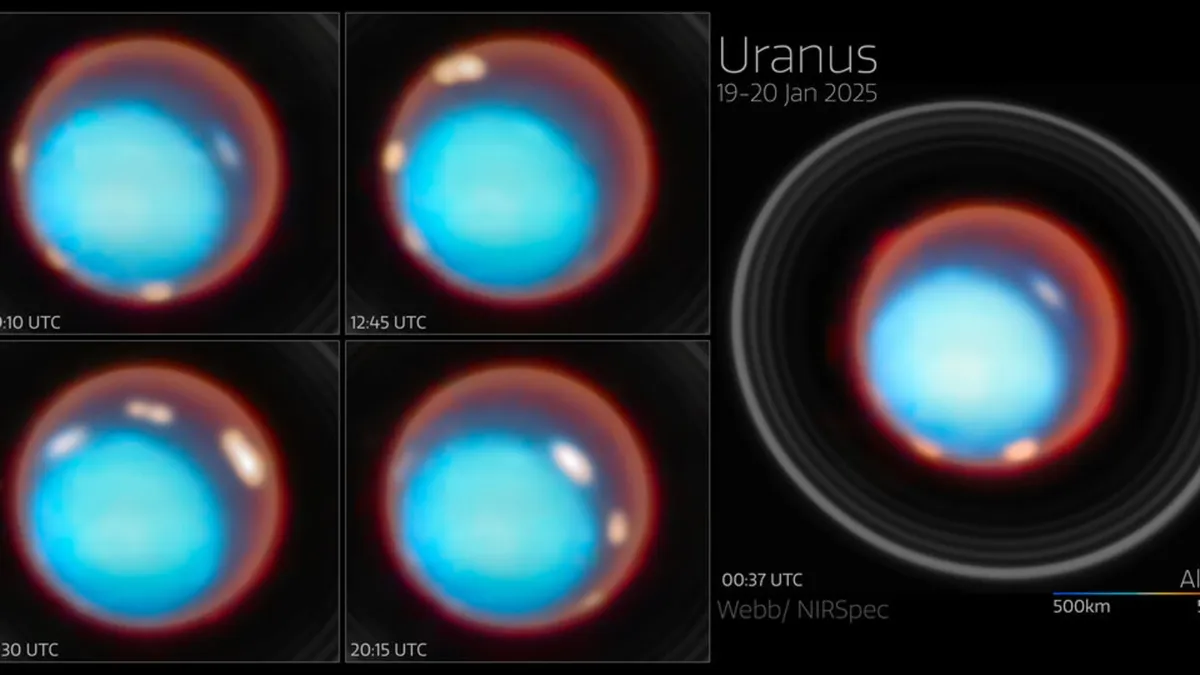
Scientists using the James Webb Space Telescope (JWST) have made significant advancements in understanding Uranus and a historic supernova. The JWST mapped Uranus’ upper atmosphere for the first time, revealing unique features of its magnetic field and auroras. Additionally, astronomers discovered a former star that exploded over 40 million years ago in a nearby galaxy, with light from the explosion reaching Earth on June 29, 2025.
Why It Matters
The observations of Uranus are crucial as they provide insights into how ice giants distribute energy in their atmospheres. The planet’s magnetic field is notably tilted by 60 degrees, resulting in auroras that extend beyond its poles, a phenomenon not seen on Earth. This research, led by Paola Tiranti from Northumbria University, highlights the complexities of Uranus’ magnetosphere, which is considered one of the strangest in the solar system.
In the case of the supernova, the discovery of the red supergiant star, which was previously observed by the Hubble Space Telescope, underscores the JWST’s capability to reveal unprecedented details in cosmic events. Lead author Charlie Kilpatrick from Northwestern University noted the significance of this supernova, stating that it is the reddest and most dusty supergiant observed to date.
What’s Next
Future studies utilizing the James Webb Space Telescope will likely focus on further exploring Uranus’ atmosphere and magnetosphere, as well as investigating other cosmic phenomena. The findings from these observations may provide deeper insights into the formation and evolution of planets and stars in our universe.