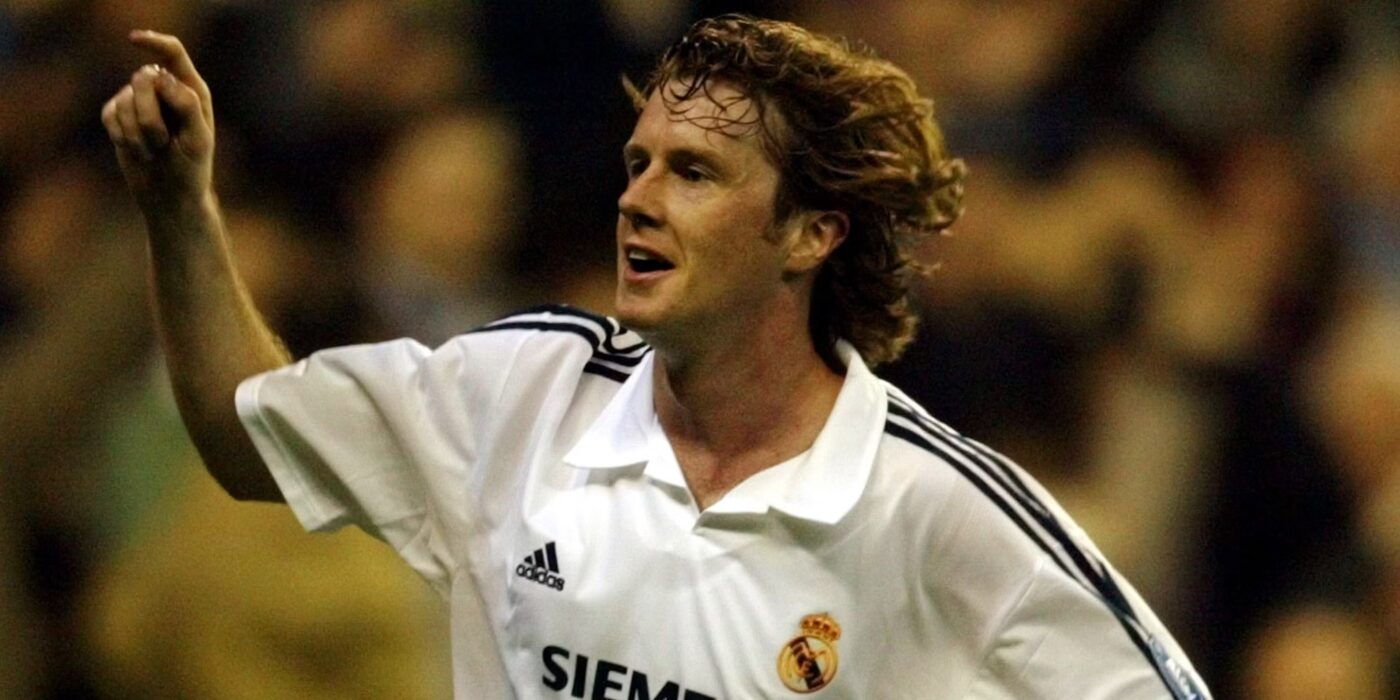
Steve McManaman built a career that still feels slightly awkward to categorise. At Liverpool, he was the roaming, unpredictable creator who lit up the mid-1990s without landing the league title. At Real Madrid, he became something rarer: an English player who moved abroad, adapted, won heavily and left with genuine respect.
Why Steve McManaman still stands apart
The legacy of Steve McManaman is not just about medals, although the medal count matters. It is about where he won them, and the manner in which he changed the usual British football story.
Liverpool’s own records list McManaman as a player from 1990 to 1999, with 364 appearances, 66 goals, an FA Cup and a League Cup to his name. That alone would be a strong Anfield career. But it is the contrast with what came next that gives his story its edge. Real Madrid record him as a midfielder who played 158 competitive games, scored 14 goals and won two Champions League titles, two league titles, the Spanish Super Cup, the UEFA Super Cup and the Intercontinental Cup during four seasons in Spain.
Most English careers of that era narrowed inwards: Premier League, England, maybe a short move overseas that did not quite take. McManaman went the other way. He left a club where he was central and joined one where he had to prove he belonged among elite European players.
That is why his career has aged well.
Liverpool made him a star, but not a champion
McManaman was one of the defining players of Liverpool’s post-title-winning 1990s. He had the gait of a winger, the instincts of a street footballer and the stamina to keep carrying the ball long after defenders thought the move should be dead.
His best Liverpool years were not always easy to frame. The team had style. It had Robbie Fowler, Jamie Redknapp, later Michael Owen. It had cup moments. It did not have the league title Liverpool supporters still craved.
McManaman’s 1995 League Cup final remains the cleanest snapshot of what he could do when given space and responsibility. Liverpool say his display against Bolton Wanderers helped secure the trophy, with McManaman scoring both goals in a 2-1 Wembley win under Roy Evans.
That match still matters because it was not just a good player contributing to a final. It was McManaman taking it over. Driving runs, changes of direction, that loose-limbed balance. He could look casual until the exact second he had beaten someone.
Liverpool’s own profile describes his Anfield career as “bittersweet”, partly because his talent produced fewer trophies than it probably deserved and partly because his Bosman move to Real Madrid left some supporters frustrated.
The Real Madrid move changed his reputation
McManaman’s exit in 1999 was uncomfortable at the time. He left on a free transfer under the Bosman ruling, with The Guardian describing him that year as a Real Madrid-bound player leaving Liverpool without a fee after his contract ran down.
For some Liverpool fans, that never fully disappeared. But football memory shifts. What looked like a painful departure became, with time, one of the most successful overseas moves by an English footballer.
Real Madrid was not a soft landing. McManaman arrived before the Galáctico era reached full force, then had to survive inside it. He was not the biggest name in the dressing room. He was not indulged as a luxury signing. He worked, moved across midfield and found a role.
His defining Madrid moment came in the 2000 Champions League final against Valencia. Real Madrid’s own historical profile singles out his volley in Paris as his standout contribution to the club’s eighth European Cup. UEFA’s archive also highlights McManaman’s goal from that 3-0 final win.
Plenty of English players have gone abroad since. Few have made the move look so normal once the ball started moving.
Why Madrid fans took to him
McManaman was not the archetypal Real Madrid superstar. He was not a 40-goal forward, nor a headline-dominating playmaker. But Madrid’s official account of his career stresses two qualities that explain his popularity there: versatility and team value. The club notes that although his natural role was on the right, he played across midfield during his time in Spain.
That mattered. In a squad packed with bigger profiles, he did not need the game built around him.
His Madrid career also had timing on its side. The Champions League win in 2000 gave him immediate credibility. Another European Cup followed in 2002. Two La Liga titles gave the spell domestic weight as well.
There is a lesson in that part of McManaman’s story. English football has often celebrated players who dominate at home. McManaman’s best case for legacy comes from adaptation — learning when to be the runner, when to be the spare man, when to stop playing like the main character.
Not every gifted player can do that.
England never quite got the full version
His England career still feels underused. EnglandStats lists McManaman with 37 caps and three goals between 1994 and 2001, with his debut coming against Nigeria in November 1994 and his final cap against Greece in October 2001.
That return does not look small in isolation. Many players would take 37 caps without complaint. But for a footballer of his technical level, in an England era often short of players comfortable carrying the ball through midfield, it feels thin.
Part of that was positional. Part was tactical fashion. England teams of the 1990s and early 2000s did not always know what to do with players who wanted freedom but were not classic No 10s. McManaman could play wide, central, tucked in, high, deeper. That should have helped. Sometimes it seemed to make him harder to pin down.
Euro 96 gave him a stage, and he was admired for his performances in that tournament. Yet his international story never matched the richness of his club career.
The Manchester City chapter was quieter
McManaman returned to England with Manchester City in 2003. UEFA reported at the time that City signed him on a free transfer from Real Madrid, after his first-team opportunities in Spain had become more limited.
It was not the part of his career that shaped how he is remembered. Still, it completes the arc: Liverpool creator, Madrid squad winner, experienced Premier League returnee.
By then, the burst had faded. The story had already been written.
What his legacy looks like now
McManaman’s football legacy sits in three places.
At Liverpool, he remains one of the club’s great modern entertainers: not the most decorated Anfield figure, but one of the most watchable. The numbers support the longevity, but the memory is more visual — the dribble, the dropped shoulder, the player gliding across the pitch without seeming fully attached to a fixed position.
At Real Madrid, he is remembered differently. Less as a maverick, more as a successful English import who understood the assignment. Four seasons, major trophies, a Champions League final goal, and enough trust to be used across midfield.
For English football, he is still a reference point whenever a homegrown player considers going abroad. Not because every move should be compared directly with his, but because McManaman proved the move could work before it became fashionable.
His career was not perfectly neat. That is part of the appeal. Liverpool gave him identity. Madrid gave him medals. England left a question mark.
FAQ
Real Madrid’s official profile lists two Champions League titles, two league titles, a Spanish Super Cup, a UEFA Super Cup and an Intercontinental Cup from his four seasons at the club.
Liverpool list McManaman with 364 appearances and 66 goals between 1990 and 1999.
Yes. He scored in Real Madrid’s 3-0 win over Valencia in the 2000 Champions League final, a goal highlighted by both Real Madrid and UEFA in their historical coverage.
He won 37 England caps and scored three goals between 1994 and 2001.
Steve McManaman’s legacy is strongest because it does not rest on one club or one moment. He was a Liverpool original who became a Real Madrid success, an English player who took the harder route and made it look, eventually, like the obvious one.