Introduction
The Magnetic North Pole is a critical point on Earth, indicating the direction of magnetic north for navigation. Its location, however, is not fixed; it shifts due to changes in the Earth’s magnetic field. Understanding the Magnetic North Pole is significant not only for navigators and explorers but also for scientists studying Earth’s geology and space weather. This article explores the importance of the Magnetic North Pole, recent movements, and implications for navigation and the environment.
Current Location and Movement
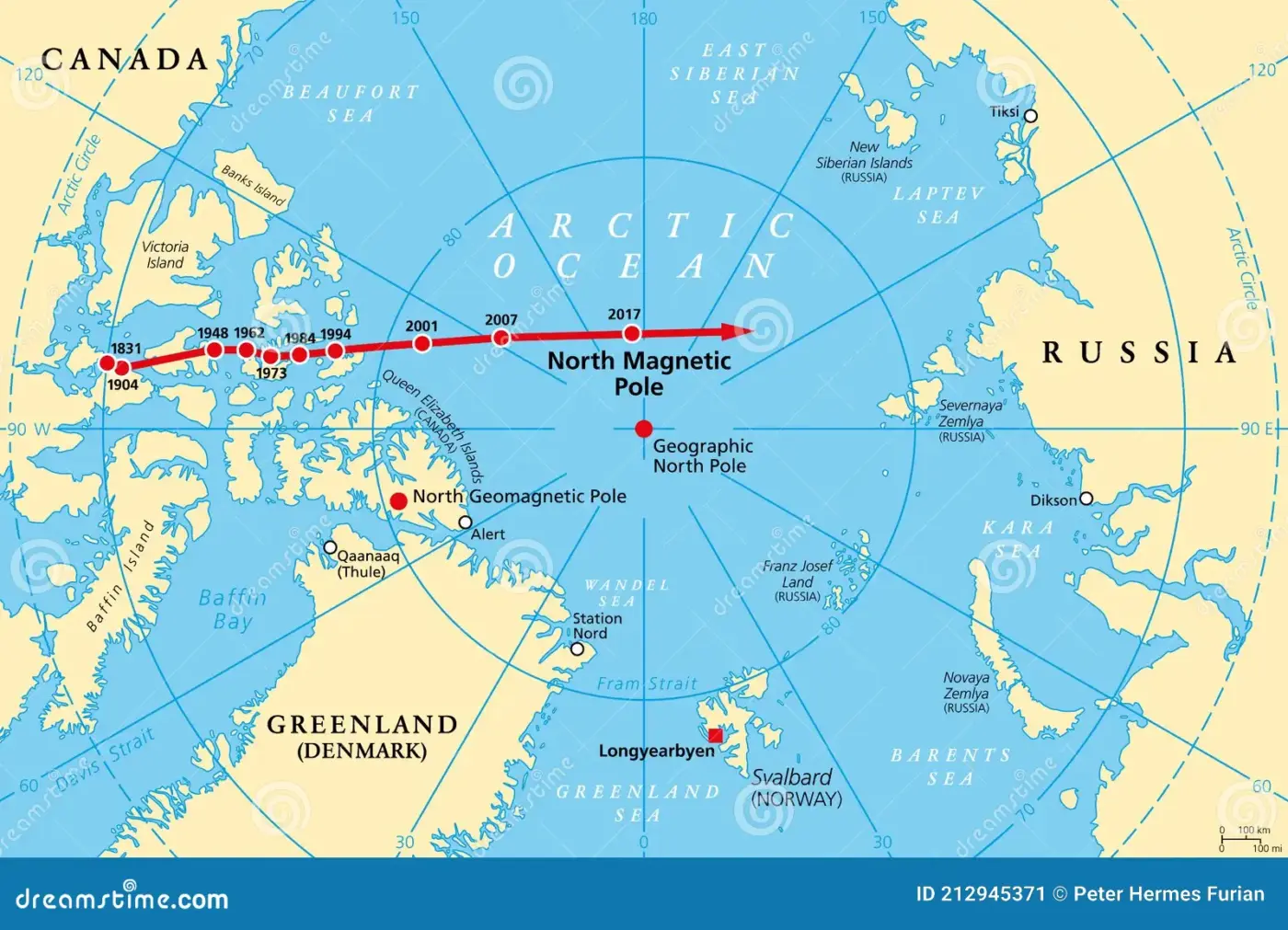
As of late 2023, the Magnetic North Pole is located in the Arctic region, moving continuously at an increasing rate. According to the latest reports from the National Oceanic and Atmospheric Administration (NOAA), it has shifted from Canada towards Russia at a speed of approximately 55 km (34 miles) per year. This acceleration in movement has raised concerns about its implications for navigation systems reliant on magnetic orientation.
Impact on Navigation
For centuries, sailors and aviators have depended on magnetic compasses for accurate navigation. With the Magnetic North Pole shifting, there’s an increased risk of navigational errors if adjustments are not made. The U.S. National Geospatial-Intelligence Agency and other organisations regularly update navigational charts to accommodate these changes. In particular, GPS technology is increasingly relied upon as it does not depend on magnetic orientation, allowing for far greater accuracy in real-time navigational guidance.
Scientific Importance
The dynamism of the Magnetic North Pole offers insights into the Earth’s core and geomagnetic processes. Researchers are studying how and why this shift occurs, considering potential implications on human activity and natural phenomena such as electrical grids. Understanding these shifts may provide answers to pressing questions regarding climate change and electromagnetic interactions.
Conclusion
The shifting Magnetic North Pole serves as a reminder of the planet’s dynamic nature. As we move forward, it is vital for navigation systems and scientific research to adapt. The increased movement of the Magnetic North Pole signifies that humans must stay informed and develop innovative solutions to ensure safety and accuracy in navigation. The ongoing study of this geomagnetic phenomenon holds promise not only for navigational technologies but also for a deeper understanding of our planet’s complex processes.